
Quality Inspection at Line Speed
How we found the problem, ran a lean pilot on the floor, and left our client owning the system and the path to scale it.
Consult NTA · forward-deployed quality control
The problem
Our client makes paper packaging, fast. At that speed, inspection is the bottleneck. A crushed corner or a bad fold is cheap to fix at the machine and expensive everywhere after. Caught at the customer, it is a credit and a hard call.
A person catches a lot of it, for a while. Across a full shift, into the thousands, it stops being a fair fight. So they asked: could a camera handle the steady part, and leave people the calls that need judgment.
A lean pilot, on the floor
We did not show up with a finished box. We started small, on site, next to their line. A pilot is for learning the real conditions fast: the lighting, the trays, the speed, the angles a demo never shows.
How it works
Two halves that stay out of each other's way. Detection is software, ejection is hardware. The camera and model run on a small computer at the line, so the call is made on the machine with no trip to a server. At line speed, a moment of lag is a missed tray.
Each tray gets one verdict, pass or fail. On a fail, a dedicated controller fires a short, timed blast of air that drops the bad tray off the belt before the next station. Good trays are never touched. Green for pass, red for reject.
Choosing the model
Off-the-shelf object detection was the obvious first try. It read clean trays well, but quietly let defects through, and a silent miss is the expensive error in QC.
So we ran a bakeoff: a classifier against anomaly detectors like PatchCore and EfficientAD, scored on one thing, how many real defects slip past. The approach that won learns only what a good tray looks like and flags anything that drifts from it.
The catch is the data. An anomaly model is only as good as the frames it learned from, and unforgiving about change. Train it on the wrong images and it calls your real line a defect. So the pipeline is the product as much as the model: capture good trays through the actual line camera, label them, calibrate to that camera, and test on trays it has never seen. Match the training to the floor and it holds.
We planned the rig before we wired it
Before any of it met a conveyor, we made a working model of the system, a map of how the parts connect and how a tray moves from seen to sorted. On a floor, the people who keep a system running are not always the ones who installed it. A picture they can poke at beats a diagram in a binder.
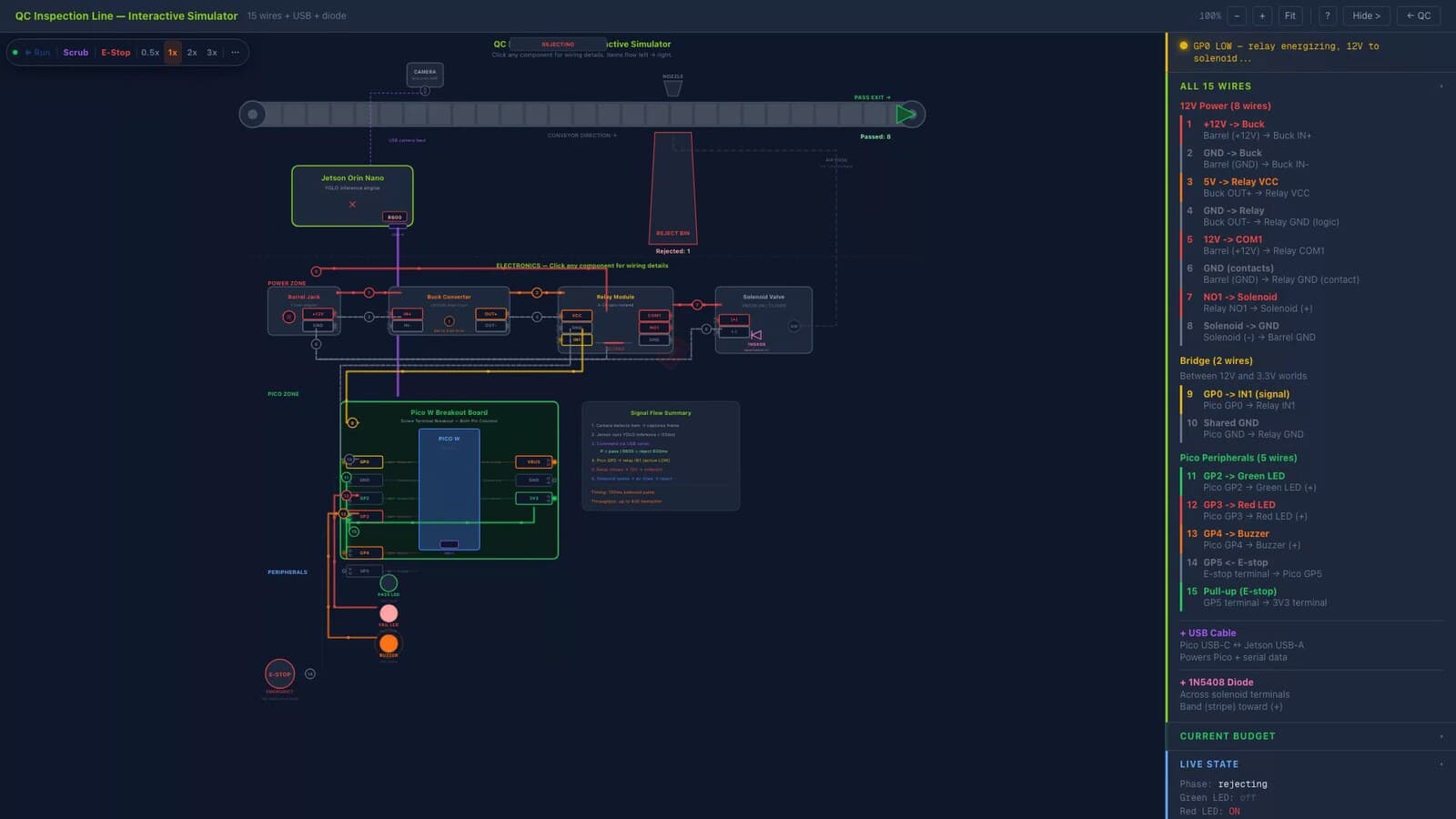
Explore the live model
Walk through the system the same way we plan it.
Open the interactive model (opens in a new tab)You own it
Here is the difference between a pilot and a product in a box. When we are done, the client owns the system and the code. The knowledge stays with their people, not locked inside a vendor they call every time something changes. The system gets stronger because the people who run it understand it.
Where it goes
This is step one. Next we make the rig proper: a real frame, a clean enclosure, hardware built for a production floor. Then we decide, part by part, what stays off the shelf and what we make custom. Then we widen the software, to more of the line and more of the checks worth automating. Each step is one the client can stand behind, because they own the one before it.
If this is your floor
If quality is the quiet tax on everything downstream, or you can already see where a camera would help, let's talk. We work lean, on site, and we leave you owning what we make.